RSS
 

Archive for the ‘Feature Stories’ Category

NFL – Throwback Thursday: The Alternating QB Experiment

29 Sep

As the NFL enters week 4 of it’s 2022 schedule, the always entertaining NFC East rivalry between Dallas and Washington is on the menu. For this week’s Throwback Thursday feature we’ll reach way back to November 4, 1962 for a matchup between the 2 clubs. It was week 8 of the season, and both the Cowboys and Redskins were competitive in the NFL’s tough Eastern Division. The New York Giants and Cleveland Browns were dominant forces in the division, and even the lowly Pittsburgh Steelers were playing well that season. Washington came into the contest with only a single defeat at 4-1-2 (ties were common in those days with no overtime) while Dallas was still in it’s infancy, in only their third season under coach Tom Landry. Still, Landry had guided them to a respectable 3-3-1 mark.

Landry, always the innovator, implemented a system on his offense in which he alternated his quarterbacks, something that would be scoffed at in today’s game considering the fragile egos of today’s signal callers. Playing 2 quarterbacks was relatively common in those days, but mostly coaches would make an in-game change solely due to poor performance or injury, since the quarterbacks took brutal beatings back then. Landry took the ploy to extremes as he changed QBs at will regularly during a game. Whether it was a sound strategy or not, it worked out well for the Cowboys on this day. Young Don Meredith got the first kick at the can. After the teams traded first quarter field goals, he connected with Lee Folkins on an 11 yard touchdown pass. Old soldier Eddie LeBaron got his turn next, and he delivered with a 23 yard scoring toss to fullback Amos Marsh. Meredith then took another turn and found J.W. Lockett on a short 4 yard throw to put Dallas in front 24-3. In the final quarter Amos Bullocks scored on a 4 yard run, then LeBaron returned and led a drive culminating in a 14 yard TD toss to Frank Clarke.

Now the rout was on. Redskin coach Bill McPeak then made the move common to the era, replacing the ineffective Norm Snead at quarterback with backup Galen Hall. Hall put together a scoring drive that he finished off himself with a touchdown scamper from a yard out. Marsh was the offensive star for the Cowboys with 10 carries for 109 yards on the ground and 3 receptions for 53 yards and the TD through the air. Dallas left town with an impressive 38-10 victory in tow, but as the season wore on both teams took a nosedive in the standings, finishing fourth and fifth respectively in the 7 team East, each with losing records.

Coach Landry eventually settled on the younger Meredith as the full time starter later in the decade, but he did revert to the alternating tactic again in the early 1970s with Craig Morton and Roger Staubach. The Cowboys finally shed their “can’t win the big one” label in 1971 when he gave Staubach the job full time. They defeated Miami that season for their first Super Bowl title.


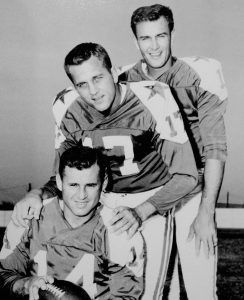
1960 Cowboy QBs LeBaron, Meredith, Don Heinrich


NFL – Throwback Thursday: Raiders Complete AFL Dominance

22 Sep

A pair of meandering NFL franchises meets on the league’s week 3 schedule, the Las Vegas Raiders and Tennessee Titans. For this week’s Thursday Throwback feature, we’ll highlight an American Football League championship game played between them on New Year’s Eve, 1967. At the time, the Titans were located in Houston as the Oilers, while the Raiders were still in their original home – Oakland. One of pro football’s most nomadic franchises, the Raiders moved from Oakland down the California coast to Los Angeles, back to Oakland and eventually to their current home in the Nevada desert.

At this point, Al Davis, who temporarily left the franchise to become AFL commissioner during merger talks with the NFL,  had built his team into a dominant force in the AFL. An October loss to Joe Namath and the New York Jets was the only blemish on an otherwise perfect season as Oakland finished 13-1, winning the AFL’s Western Division crown by a whopping 4 games over rival Kansas City. Houston, under coach Wally Lemm, reversed their fortunes from the previous season, turning a 3-11 record into a 9-4-1 mark that proved good enough to win the Eastern Division title and a trip to Oakland for the championship match.

Although Lemm’s club managed to wrestle the crown from three-time East champion Buffalo and the up-and-coming Jets, they proved to be no match for the Raiders in the title game. Oakland’s rugged defense smothered the Oiler attack, holding them to 146 total yards on the day and forcing 4 fumbles and an interception. Offensively, Raider quarterback Daryle Lamonica completed only 10 passes, but 2 of those went for touchdowns, 17 yards to tight end Dave Kocourek and 12 yards to Bill Miller. Oakland’s offense demolished the Oilers with a relentless ground attack, as both Hewritt Dixon (144) and Pete Banaszak (116) ran for over 100 yards. Dixon’s total included a 69 yard scoring run. Lamonica added a 1 yard touchdown run and George Blanda booted 4 field goals to complete the Raiders’ scoring in a 40-7 rout of the Oilers that was never much of a contest. The beleaguered Houston club could only manage a fourth quarter 5 yard TD pass from Pete Beathard to Charley Frazier, avoiding a shutout but not being very satisfied with the result.

Having bulldozed through the AFL in winning 14 of 15 games, the Raiders appeared to have a team capable of competing with the NFL’s juggernaut Green Bay Packers in the second Super Bowl, following a 35-10 thrashing of Kansas City by the Packers the previous season. Vince Lombardi’s troops, after all, had to muster every ounce of fortitude they had to dispatch the Dallas Cowboys in the “Ice Bowl” to make it back to the big game. Alas, Oakland’s lack of experience showed in the game, and mistakes led to another resounding Packer victory, 33-14.


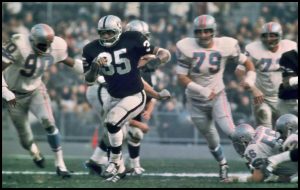
FB Hewritt Dixon outruns Oiler defenders


NFL – Throwback Thursday: Fighting For Their Playoff Lives

15 Sep

It’s week 2 of the NFL season and on this week’s schedule the New York Jets tangle with the Cleveland Browns, leading us at Rayonsports to travel back to December 10, 1978 for a late season meeting between these franchises. Both clubs entered the game on the fringes of the AFC playoff race. The Jets stood at 8-6 and trailed both New England and Miami in the AFC East, while the Browns languished at 7-7, ranking third in the AFC Central. With their faint playoff hopes on the line, the 2 teams battled feverishly to stay alive.

Cleveland jumped out to a 14-0 lead as Calvin Hill ran in from 2 yards out for the only score of the first quarter, and quarterback Brian Sipe hit Greg Pruitt with a 22 yard touchdown pass. The teams traded second quarter field goals, and Matt Robinson, subbing since early in the season for the injured Richard Todd, pulled the Jets to within 17-10 at the half with a short scoring toss to Bruce Harper. Cleveland again took charge in the third stanza as veteran placekicker Don Cockroft added another field goal and Sipe scampered into the end zone from 2 yards out, upping the lead to 27-10. Coach Walt Michaels’ Jets refused to fold, however. Robinson engineered a pair of touchdown drives, finishing them off with TD throws of 4 yards to tight end Mickey Shuler and 20 yards to Harper. After Pat Leahy hit a 39 yard field goal and Kevin Long scored on a 1 yard plunge, the Jets had run off 24 unanswered fourth quarter points and found themselves in the lead at 34-27. Coach Sam Rutigliano’s Browns, who had been dubbed the “Cardiac Kids” for pulling off a series of comebacks and late game heroics, dug down deep and drove downfield with Sipe hitting Hill for an 18 yard touchdown with 14 seconds left to tie the game and force overtime.

Cockroft ruined the day for the Jets by connecting on his third field goal, from 22 yards out, to give Cleveland a 37-34 victory. The hard-fought battle went for naught for both clubs. When Miami and the old Houston Oilers both won to clinch the final AFC wild card spots, both Cleveland and New York were officially eliminated. They each finished the season with mediocre 8-8 records after that, and this game took a toll the following week as both teams appeared deflated. The Jets lost to Dallas 30-7 and the Browns were pummeled by Cincinnati 48-16 in the season’s final games.


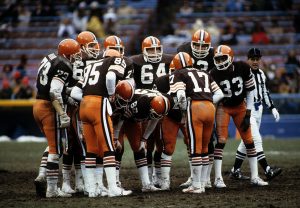
Sipe and the Browns huddle up


NFL – Throwback Thursday: A Wild Card Shootout

08 Sep

The 2022 NFL season is upon us, beginning with the league’s Thursday Night opener in Los Angeles. The start of the new season also marks the return of our weekly Throwback Thursday feature, which highlights a game from the past played between 2 teams that are pitted against each other on the schedule that week. The schedule makers have the Detroit Lions meeting the Philadelphia Eagles in week 1 this season, so we’ll travel back to December 30, 1995 for a Wild Card playoff matchup between this pair of old NFL clubs.

The game saw the Eagles’ quarterback, Rodney Peete, matched up against the team he had spent the first 5 years of his career with in the Lions. The teams traded first quarter touchdowns as Charlie Garner scampered 15 yards to paydirt for Philly and Detroit QB Scott Mitchell tossed a 32 yard touchdown pass to David Sloan. The fortunes for the 2 signal callers, Peete and Mitchell, changed drastically after that. Peete guided the Eagles on a scoring rampage that stretched into the third quarter, as Philly racked up 51 unanswered points. Meanwhile, Mitchell’s day went south, as he was sacked twice and threw 4 interceptions before being replaced by Don Majkowski. The Eagles’ scoring onslaught included 3 TD passes from Peete to Fred Barnett, Ricky Watters and Rob Carpenter, a 1 yard touchdown run by Watters and 3 Gary Anderson field goals. The defense also chipped in, as Barry Wilburn returned one of the picks from Mitchell 24 yards for a touchdown.

Now trailing 51-7 in the third quarter, Detroit coach Wayne Fontes inserted Majkowski into the game hoping to at least regain some pride. The “Magic Man”, as Majkowski had been dubbed in earlier years while with Green Bay, lived up to the moniker. He proceeded to lead touchdown drives in the final 2 quarters that ended with 4 touchdown passes, including a 68 yarder to Herman Moore. Unfortunately for the Magic Man, the Philadelphia defense intervened in the comeback and stemmed the tide of Detroit scoring when William Thomas picked off a Majkowski pass and returned it 30 yards for the Eagles’ second pick six of the game. When the dust finally settled, Philly escaped with a 58-37 victory. Despite surrendering the 37 points, the Eagle defense had a stellar day with 6 total interceptions and the 14 point contribution to the scoring. The win was the highlight of the ’95 playoffs for Philadelphia. They were routed by the eventual Super Bowl champions, coach Barry Switzer’s Dallas Cowboys, 30-11 the following week in the divisional round.


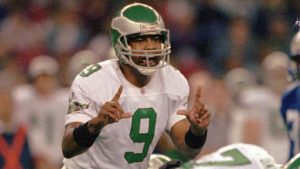
Eagle QB Rodney Peete scans the defense


NFL – Throwback Thursday: The Alley Oop Is Born

06 Jan

It’s the final week of the NFL regular season, which is a sad time for me since it means the final Throwback Thursday feature of the season. Two old western rivals, the Los Angeles Rams and San Francisco 49ers, close out the year with a game against each other. For the final TBT post of 2021, we’ll look back on a game from October 6, 1957 played between these 2 clubs that became the birthplace of a play from those early years of the NFL, the “Alley Oop” pass. Both the Rams and 49ers boasted exciting offensive clubs in the 1950s. The Rams featured a future Hall of Fame coach in Sid Gillman and a pair of Hall of Famers in Norm Van Brocklin and Elroy “Crazy Legs” Hirsch, while San Fran’s attack came courtesy of their “Million Dollar Backfield” combination of QB Y.A. Tittle, halfbacks Hugh McElhenny and Joe Perry and fullback John Henry Johnson, all future Hall of Famers.

Despite already being the first week of October, this was only the second game of the season for these California rivals. The NFL played a 12 game schedule in those days, and the season started later. The 49ers were coming off an opening week loss while the Rams had won their first game. Rams’ running back Tommy Wilson quieted the boisterous Kezar Stadium crowd with a 21 yard touchdown run, the only scoring in the first quarter. San Francisco grabbed the momentum back when they pinned the Rams on their own goal line, and Leo Nomellini burst through and tackled Wilson in the end zone for a safety. Tittle then took charge, leading a pair of scoring drives which he topped off with touchdown throws of 23 yards to Billy Wilson and 46 yards to R.C. Owens, his favorite target. That gave the Niners a 16-7 halftime lead, but Tittle and the offense went cold in the second half. Van Brocklin, the proud warrior, connected with Leon Clarke on a 70 yard touchdown bomb, and while the San Francisco offense continued to sputter, the Rams added a pair of Paige Cothren field goals to open up a 20-16 lead.

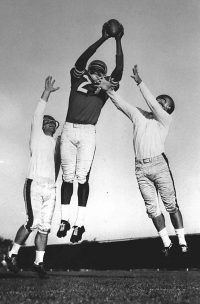
49er coach Frankie Albert, in an attempt to light a fire under his struggling offense, decided to attempt a trick play when Tittle drove the club into the red zone as the game clock wound down. It had been dubbed the “Alley Oop” pass, and it entailed Owens running to a spot in the end zone and Tittle lofting the ball high to a spot where the athletic Owens would outleap any defender and come down with a completion. The play worked, as Owens snagged the pass for an 11 yard game-winning touchdown in a 23-20 49er win.


R.C. Owens demonstrates the “Alley Oop” at practice


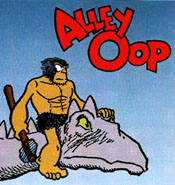
In today’s NFL, that play is commonplace and known as “high-pointing” the ball or perhaps as the “back shoulder” throw, or “Hail Mary” pass. Tall, athletic receivers and tight ends are all used as “red zone” targets, plus today’s players are making amazing athletic plays every week. But in 1957, the play was a big deal. It was named after a comic strip caveman of that name and of that era. There was also a novelty pop song about the caveman, recorded by The Hollywood Argyles, being played on pop radio stations at the time. The term has long vanished from football jargon today, but is still used in basketball to define an above-the-rim pass to a teammate to set up a dunk. Owens made enough of an impression in San Francisco to earn a place in the team’s Hall of Fame, and he also can make a claim to fame for changing the rules of the game. He used his jumping abilities in a game once to bat away a field goal attempt by leaping up over the crossbar and knocking it away. The NFL outlawed “goaltending” the next season.


Alley Oop, the cartoon caveman

 
Comments Off on NFL – Throwback Thursday: The Alley Oop Is Born

Posted in Feature Stories, Football


NFL – Throwback Thursday: The Prodigal Son Returns

30 Dec

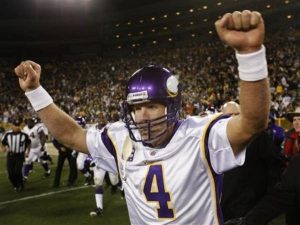
The Green Bay Packers will try to hold on to their top seed in the NFC this week when they take on the Minnesota Vikings in a week 17 matchup on the schedule. We’ll throw it back a decade or so for our Throwback Thursday feature, to November 1, 2009. That’s the day when the Packers’ prodigal son, Brett Favre, returned to Lambeau Field as a member of the enemy squad, the Vikings, to try to extract some revenge on his former team. Favre, a Packer legend who had guided the team to a pair of Super Bowls, winning one, was unceremoniously traded to the New York Jets in 2008. Coach Mike McCarthy made the decision to move on from him at that time and hand the quarterback reins to young Aaron Rodgers, who had sat patiently for 3 seasons behind Favre waiting for his opportunity. So this was billed as a showdown between the old hero turned villain and the fresh new young gun. Favre had already beaten the Packers earlier in the season in Minnesota in a game in which he threw 3 touchdown passes, and the Vikings entered this rematch at 6-1 and leading the NFC North, with Green Bay right behind them at 4-2.

Packer fans booed their former idol heartily when he came out of the tunnel and throughout the game. After all, playing for the Jets was acceptable, but Favre had retired, then came out of retirement to sign with the Packers’ hated division rival. Mason Crosby opened the scoring with a field goal for Green Bay, but the Vikings, behind Favre, took control after that. Adrian Peterson, who rushed for 97 yards on the day, scored from a yard out. Favre followed that up with a 12 yard TD toss to Visanthe Shiancoe, and when Ryan Longwell booted a 41 yard field goal, Minnesota went into the half with a 17-3 lead. Favre continued the onslaught with a 51 yard heave to Percy Harvin to extend the Viking lead to 24-3, but the Packers and Rodgers gathered themselves and began to close the gap. Crosby hit another three pointer, then Rodgers connected twice with his tight end, Spencer Havner, on short scoring throws. Green Bay had now shortened the lead to 24-20 going into the final quarter.

The two gunslinging signal callers continued their battle as the game wound down. Favre flipped a short 2 yard touchdown toss to Jeff Dugan, and Rodgers matched that by finding Greg Jennings for six from 10 yards out. Green Bay failed on a two point attempt, so the Vikings now led 31-26. It was a valiant comeback, but Favre and his new team would have the last laugh. Green Bay’s prodigal son hit Bernard Berrian with a 16 yard throw for his fourth touchdown pass of the day, cementing Minnesota’s 38-26 win. The Viking defense, and their offensive line, were the difference in the game. Favre threw from a clean pocket all day, while Rodgers, despite passing for more yardage than Favre, was sacked 6 times. It turned out to be a pretty good move by Minnesota in signing the aging Favre. The club continued on it’s winning ways, clinching the division title with a 12-4 record and advancing all the way to the NFC Championship, where they lost a heartbreaker 31-28 to the eventual Super Bowl champion New Orleans Saints.


Brett Favre celebrates beating his old team

 
Comments Off on NFL – Throwback Thursday: The Prodigal Son Returns

Posted in Feature Stories, Football


NFL – Throwback Thursday: The Juice Is Loose!

23 Dec

A pair of AFC East contenders square off for the second time in a month this Sunday on the NFL’s schedule – the New England Patriots and Buffalo Bills. Our Throwback Thursday feature this week highlights a game played between these 2 teams on opening day of the 1973 season. It was played at New England’s old Shaefer Stadium on September 16 of that year. Both clubs had shown promise in the 1972 season that they might be able to find the promised land of fielding winning teams in this new year. The Bills brought back their old coach from the AFL days, Lou Saban, in ’72 to try to salvage the career of young running back O.J. Simpson, who had languished in his first couple of seasons under coach John Rauch. Rauch came up with the foolish idea of using Simpson as a decoy instead of featuring his talent in the offensive scheme, and even toyed with the idea of switching him to wide receiver. Saban changed all that, building the club around Simpson’s talent to feature the running game. The Bills were also set to move out of their old stadium, the decrepit War Memorial Stadium, into their shiny new home, Rich Stadium.

The Patriots also entered the ’73 season with high hopes, as new coach Chuck Fairbanks attempted to improve the club with young quarterback Jim Plunkett being fortified with an influx of new talent that included Sam Cunningham, Darryl Stingley, John Hannah and Ray “Sugar Bear” Hamilton. That new talent paid immediate dividends as Cunningham scored the game’s first touchdown on a 7 yard run. The Pats missed the extra point, taking a 6-0 lead. It didn’t last long, as a portent of things to come was about to happen. The Bills took the field with a revamped offense designed to feature Simpson’s ability. Three draft picks became immediate starters. A pair of first rounders, Paul Seymour and Joe DeLamielleure, manned the tight end and guard spots, and Joe Ferguson took over for Dennis Shaw at quarterback. Seymour’s role was basically an extra tackle on the line to help Simpson, and when “The Juice” broke off an 80 yard touchdown run to give the Bills a 7-6 lead, Buffalo was off and literally running. Buffalo’s rebuilt line also added center Mike Montler in a trade to go with Reggie McKenzie, Donnie Green and Dave Foley, forming what would be nicknamed the “Electric Company” as they turned on “The Juice”. John Leypoldt added a field goal and Larry Watkins, O.J.’s backfield mate, scored on a 4 yard run to boost the Bills to a 17-6 lead before New England pulled to within 17-13 on a 10 yard Mack Herron run. Then Simpson scored again on a 22 yard scamper. Watkins again joined in the fun, rambling 15 yards to close out the scoring and give Buffalo a resounding 31-13 victory.

When the final gun sounded, Simpson had accumulated 250 yards rushing on 29 carries with his pair of touchdowns, setting a new single-game record for ground yards. Watkins added another 105 yards on 18 carries and his 2 TDs as the Bills racked up an impressive 360 yards on the ground in the game. Simpson’s performance wasn’t a one time deal. He would go on to break Jim Brown’s single season rushing yards record and become the first player in history to break the 2,000 yard barrier as he finished with 2,003 for the year. He is still the only back to achieve the feat in 14 games. Simpson’s personal life has turned tragic and he has frittered away any good will he may have earned in his playing days and broadcasting and acting careers afterwards, but he was a dynamic athlete at one time.


O.J. Simpson shredded the Pats for 250 yards on opening day


Comments Off on NFL – Throwback Thursday: The Juice Is Loose!

Posted in Feature Stories, Football


NFL – Throwback Thursday: Gateway To A Victory

16 Dec

We’re headed into the home stretch of the NFL season, and one of this week’s games matches the team with the best record, the Arizona Cardinals, against the club with the worst mark, the Detroit Lions. These 2 teams met in a game played on October 1, 1967 at St.Louis’ Busch Stadium, when the Cardinals were located in the Gateway To The West city. Both of these teams were perennial also-rans in the 1960s, but it didn’t keep them from providing fans with some exciting games during the decade. This game veered from the usual “three yards and a cloud of dust” style of 1960s NFL football. It turned into what qualified as a shootout in that era between Detroit veteran signal caller Milt Plum and the Cardinals’ young second year gunslinger, Jim Hart.

The Lions came out swinging and took an early 7-0 lead with a drive that ended on a one yard scoring plunge by Mel Farr. Detroit then pinned the Cards deep in their own territory, and when Hart tried to throw out of his own end zone Larry Hand picked it off at the 2 yard line and walked into the end zone to up the lead to 14-0. St. Louis finally found their bearings in the second quarter and Hart guided them to a couple of scores, with halfback Johnny Roland finding paydirt from a yard out and Jim Bakken booting a 39 yard field goal to put the game within striking distance at 14-10. Plum took to the air and found his favorite target, Pat Studstill, on a 37 yard touchdown throw to extend the lead to 21-10. When Roland found the end zone again for the Cards, on another 1 yard run, the gap was closed to 21-17 at the half.

The Cardinals came out of the locker room rejuvenated in the second half, and took the lead when Hart hit his tight end, Jackie Smith, with a 57 yard touchdown bomb. Roland scored his third rushing touchdown, from 6 yards out, to end the third quarter scoring, and St. Louis suddenly found themselves up 28-17. The Lions fought back in the final quarter, and Plum and Studstill connected again, on a 23 yard scoring pass. Plum finished with 206 yards passing for the day, a sizable amount for a game in those days, with Studstill amassing 107 of those yards on 5 catches. Hart had a favorite target that day also in split end Billy Gambrell, who also had 5 receptions, for 117 yards. The biggest of the connections for the Cardinal duo resulted in a 48 yard touchdown that completed the scoring. When the final gun sounded, St. Louis had themselves a hard-fought 38-28 victory.


Johnny Roland stopped by the Lions’ defense


Both clubs settled into their usual mediocrity as the season wore on, with the Cardinals finishing third in the league’s Century Division at 6-7-1, and Detroit also winding up third in the Central Division at 5-7-2. There was at least a hint of hope in Detroit in the ’67 season as the Lions boasted both the NFL’s Offensive and Defensive Rookies of The Year in Farr and Lem Barney.


Cards vs. Lions game program


Comments Off on NFL – Throwback Thursday: Gateway To A Victory

Posted in Feature Stories, Football


NFL – Throwback Thursday: The Enigma Quarterback

09 Dec

The oldest rivalry in pro football gets renewed this week on the NFL schedule as the Chicago Bears take on the Green Bay Packers. For this week’s Throwback Thursday feature we’ll travel back to November 4, 1973 for a matchup between these 2 historic franchises. By the ’73 season, the Packers were long past the Vince Lombardi dynasty years, and the Bears’ founder, owner and coach George “Papa Bear” Halas had moved from the sideline into the front office to run the club. The teams were now coached by a couple of forgettable names – Dan Devine with Green Bay and the large, jovial Abe Gibron for the Bears. Both teams were foundering, with the Packers at 2-3-2 and Chicago a lowly 2-5, entering the game.


Bears’ coach Abe Gibron, large and in charge

The Bears’ quarterback at the time was an NFL enigma. A novelty in 1973 but perhaps a player well ahead of his time, he was Bobby Douglass, a 6’4″ 225 lb. corn-fed Kansas boy. Douglass was a couple of things that didn’t mesh with NFL football quarterbacks at the time. He was left-handed, and he was a runner rather than an effective passer. His career passing statistics are cringe-worthy – in 10 seasons, he threw for 36 touchdowns and 64 interceptions and had a career QB rating of 48.5. Nevertheless, he paved the way for southpaw throwers like Ken Stabler and later Steve Young to be accepted despite being lefty and having run game skills. It could be argued that Douglass was the original lab experiment and Young the perfected final product.

Back to the November 1973 game. It was at Lambeau Field in Green Bay, an intimidating place for visiting teams in the Lombardi era but not so much now. This was a matchup between Douglass and the heir apparent to Bart Starr, a not-so-legendary signal caller named Scott Hunter. The pair traded first quarter touchdowns as Douglass opened the scoring on a 1 yard run, with Hunter answering on a 5 yard scoring toss to MacArthur Lane. In the second stanza Hunter ran in from a yard out and the clubs traded field goals, putting Green Bay ahead 17-10 at the half. The second half turned out to be the Bobby Douglass show. He accounted for all the scoring with 3 more short TD runs, giving him a total of 4 six-pointers on the day as he amassed an even 100 yards rushing on 18 carries. His passing stats were unspectacular but efficient, as he hit on 10 of 15 throws for 118 yards in his team’s 31-17 victory. In all the Bears rushed for 230 yards while their defense made life miserable for Hunter. He completed only 3 of 15 passes for a meager 17 yards. The only offensive bright spot for the Packers was the 119 yards gained on the ground by Lane and John Brockington, who was a very underrated running back in the post-Lombardi Packer era. Unfortunately for the Bears, this would be the last game they won in the ’73 season as they finished 3-11 for last place in the NFC Central Division. Green Bay managed a bit more success, but not much more as they wound up just ahead of the Bears in the standings at 5-7-2.


Packer defenders spent the day chasing Douglass

 
Comments Off on NFL – Throwback Thursday: The Enigma Quarterback

Posted in Feature Stories, Football


NFL – Throwback Thursday: Archie Has A Day

02 Dec

This week on the NFL schedule, the Dallas Cowboys meet the New Orleans Saints, and we’ll feature these 2 teams as our Throwback Thursday game. They met on October 17, 1971 at Tulane Stadium, the Saints’ home field at the time. The Saints, who entered the league as an expansion team in 1967, hadn’t gotten off the ground in the first 4 years of their existence, but in 1971 were ready to finally find some success behind their shiny new rookie quarterback, Archie Manning. The ’71 season started slowly for the Saints, as they entered this contest with a 1-2-1 mark, while Dallas, having endured a crushing last-second Super Bowl loss in 1970, won 3 of their first 4 games. Cowboys’ coach Tom Landry, trying to get his club past the “can’t win the big one” curse, brought in seasoned veterans for the ’71 campaign who had won titles with other clubs, players like Mike Ditka, Herb Adderley, Lance Alworth and Gloster Richardson. New Orleans had at least shown some respectability and competitiveness so far this season, but this was a chance to show they were ready to emerge as a rising team.

They did just that as they came out playing inspired football, dominating the first half. Manning threw a 29 yard touchdown pass to Tony Baker for the only scoring in the first quarter. In the second quarter, Charlie Durkee connected on a field goal and Manning finished a drive by taking matters into his own hands, scrambling 13 yards for a score to give his team a shocking 17-0 lead at halftime over the defending NFC champs.  Landry made the decision at the half to replace ineffective starter Craig Morton, who had been intercepted twice, at QB with the dangerous Roger Staubach, who was a scrambler that could create some offense. The move worked, as Staubach fired a 41 yard touchdown pass to Richardson for the only score of the third quarter, then hit “Bullet” Bob Hayes  from 16 yards out to bring the Cowboys to within 3 at 17-14. However, when Manning ran in from 2 yards out for another score, the Saints secured a 24-14 win and sent their fans home happy and with hope for a winning season.

It didn’t work out that way, as New Orleans stumbled to a last place 4-8-2 record. Dallas, on the other hand, took some positives from the loss. Landry, who had foolishly entered the year with a plan of alternating quarterbacks with Morton and Staubach, eventually settled on Roger the Dodger as the starter, and he led the Cowboys to their first Super Bowl title that season, a resounding victory over the young Miami Dolphins. The club’s first championship win, exorcising the losing demons at last, took place right back at the site of this game, Tulane Stadium.


Saints’ Archie Manning challenges the Doomsday Defense

 
Comments Off on NFL – Throwback Thursday: Archie Has A Day

Posted in Feature Stories, Football