RSS
 

NFL 100 – Don Shula

10 Oct

One of last week’s NFL 100 posts featured one of pro football greatest but under the radar head coaches in Chuck Noll, architect of the great Pittsburgh Steeler dynasty of the 1970s. This week, we’ll feature the winningest head coach of all time in the NFL, the great Don Shula. Noll and Shula both played for Paul Brown in Cleveland, but prior to Noll’s rookie season, Shula was traded to the Baltimore Colts. He played there for 4 seasons and played a year in Washington before retiring. His playing days didn’t amount to much but in 1960 he would embark on a coaching career that would take him to the top of the mountain in the NFL. He signed on as the head defensive coach of the Detroit Lions (they didn’t designate them as “coordinators” at the time). After doing an impressive job there, he returned to the Colts as their head coach in 1963 and quickly made the team into a force in the league. They reached the title game in 1964 and 1968, losing to Cleveland in ’64 and then beating the Browns in ’68. They finished with an identical 10-3-1 record with Vince Lombardi’s Green Bay Packers in 1965 and because of injuries were forced to use halfback Tom Matte at QB in a playoff game against the Packers to decide the Western Conference champion. The teams were tied 10-10 when Green Bay’s Don Chandler kicked a controversial field goal to win the contest 13-10. Replays appeared to show that the kick was actually no good, and it resulted in the NFL raising the goalposts to their current height. In the 1967 season, the Colts entered the regular season’s final week undefeated but a loss to the Rams, who also hadn’t lost a game, cost them the Coastal Division crown and a place in the playoffs despite finishing 11-1-2. Despite fielding competitive teams in all of his 7 seasons in Baltimore, it was a huge upset loss, to Joe Namath’s New York Jets in Super Bowl III, that ultimately got the coach the heave-ho there. He coached one more season after the loss but the Colts finished 8-5-1 and he was fired.

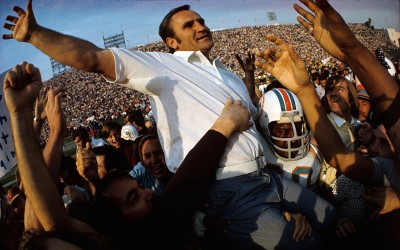
That turned out to be a major blessing for Shula. He moved on to take the reins of the Miami Dolphins, a foundering expansion franchise in the AFL, and built them into a powerhouse of the early 1970s that won back-to-back Super Bowls in 1972 and ’73. The ’72 season was remarkable in that the Dolphins finished 17-0 to become the only team in NFL history to go undefeated, a mark still unmatched today. His teams won with a pounding running game and a stingy defense dubbed the “No Name” defense because it lacked any big stars. Although the Steelers and Noll stole a bit of their thunder when they won 4 Super Bowl titles the rest of the decade of the ’70s, Shula kept his team competitive through 2 more decades until he retired as pro football’s winningest coach in 1995. Overall his teams reached 6 Super Bowls and won a pair, and while accumulating his record 347 victories he coached different styles of play, going from a star QB in Baltimore, John Unitas, to the bruising run game, stingy defense of his ’70s teams to a wide open passing offense with Dan Marino. He is a coaching legend indeed in NFL football lore – the winningest coach in the league’s 100 year history that is being celebrated this season.


don-shula-sportsman-of-the-year

Triumphant coach Shula carried off the field after Super Bowl VII


Comments Off on NFL 100 – Don Shula

Posted in Feature Stories, Football


Classic Team Logo of The Day

10 Oct

towsontigers

Logo of a small college football team that plays in the Colonial Athletic Conference, the Towson University Tigers. Their gridiron program has existed since 1969 and they currently play their home games at Johnny Unitas Stadium in Towson, Maryland. Some Tiger alumni who have gone on to play pro football include Sean Landeta, Dave Meggett, Jermon Bushrod, Chad Scott and Madieu Williams.

 
Comments Off on Classic Team Logo of The Day

Posted in Classic Team Logo of the Day


Classic Sports Card of The Day

10 Oct

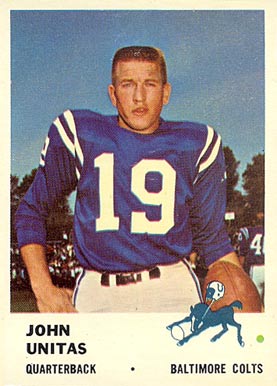
61fleerunitas

1961 Fleer football card of one of the top pro football quarterbacks of all time, John Unitas. “Johnny U” played 18 seasons in the NFL, mostly with the Baltimore Colts. He was a 10-time Pro Bowler, 4-time NFL champion, 3-time NFL MVP, All Decade team for the 1960s, and a 4-time league leader in passing yards and touchdown passes. His record of 47 consecutive games with a touchdown pass stood for almost 52 years before being broken by Drew Brees in 2012. Unitas was enshrined in the Pro Football Hall of Fame in 1979, and died of a heart attack in 2002.

 
Comments Off on Classic Sports Card of The Day

Posted in Classic Sports Card of the Day


NFL – Throwback Thursday: Right Player, Wrong Uniform

03 Oct

It’s Throwback Thursday time again as week 5 of the NFL schedule approaches, and the game on this week’s slate that we’ll match up with is a battle between the New York Giants and Minnesota Vikings. It’s the second week in a row we highlight a game involving the G-Men, and this one harkens back to September 21, 1969, when the Giants played at Yankee Stadium. It’s important because it’s a Viking contest involving one of the icons of that franchise, quarterback Fran Tarkenton. The thing is, on this day, Tarkenton was the quarterback for the Giants. After being the face of the franchise from the beginning, in 1961, until 1966, he had been traded to the Giants prior to the 1967 season. This game wasn’t the first time he got the chance to face his old club. The two teams met in Minnesota in ’67 and although Tarkenton did yeoman’s work by throwing for 3 touchdowns, the Vikings prevailed 27-24. This time the game looked like it might go the same way. The scrambling Tarkenton threw a 54 yard scoring pass to Homer Jones and led a drive to a field goal, but the Vikings’ QB, Gary Cuozzo, bested that by hooking up with his wide receivers, John Henderson and Gene Washington, on long touchdown passes as the Vikings pulled ahead in the fourth quarter 23-10. Washington had a big day with 7 receptions for 152 yards and the TD.

The determined Tarkenton was never one to give up, though, and on this day, he hunkered down and engineered a pair of scoring drives late in the game. Using his patented scrambling style, some tough running from Tucker Frederickson and pinpoint passing, he hit flanker Don Hermann twice for touchdowns, from 16 and 10 yards out, to pull out a 24-23 win for New York. It was a gratifying season-opening victory for Fran and his team, but wasn’t a harbinger of things to come for either team in the 1969 season. The Giants wound up 6-8 while Minnesota lost only one other game all season on their way to the NFL title, before being upset by the Kansas City Chiefs in the Super Bowl. However, they were a strong team for sure. The 24 points they gave up to Tarkenton and the Giants on this day was the most they would surrender in a single game all season. Tarkenton, incidentally, would be traded back to the Vikings after spending 5 seasons in New York and lead them to the Super Bowl 3 times, losing all three.


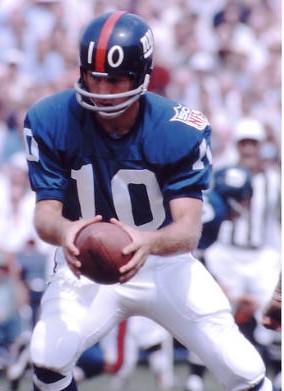
tarkentonNY (2)

Fran Tarkenton with the Giants in 1969, the NFL’s 50th season

 
Comments Off on NFL – Throwback Thursday: Right Player, Wrong Uniform

Posted in Feature Stories, Football


Classic Team Logo of The Day

03 Oct

nygiants752599

This is a logo commemorating the New York Giants’ 75th anniversary season, which they celebrated in 1999. The team, under head coach Jim Fassel, had a losing season that year but came back the next season to advance to the Super Bowl. The franchise is one of the NFL’s most historic, with their 19 championship game appearances ranking as the most of any team all time. They have won 8 titles, with only Green Bay (13) and Chicago (9) winning more. The Mara family, beginning with Tim in 1925 and continuing today with his grandson John Mara, have owned the club since its’ inception.

 
Comments Off on Classic Team Logo of The Day

Posted in Classic Team Logo of the Day


Classic Sports Card of The Day

03 Oct

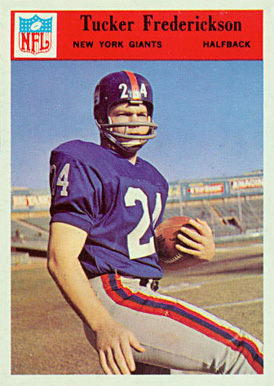
66philafrederickson

1966 Philadelphia football card of former pro football running back Tucker Frederickson, who was the top pick of the college draft in 1965 and spent 7 seasons with the New York Giants. He was a Pro Bowler in his rookie year but his career tailed off some after that and ended prematurely due to a knee injury in 1971. In retirement, Frederickson became involved in the financial industry and handles golf course real estate business, with his partners including Jack Nicklaus.

 
Comments Off on Classic Sports Card of The Day

Posted in Classic Sports Card of the Day


NFL 100 – AFL Quarterbacks

03 Oct

As I have already stated in earlier NFL 100 posts, the story of the league’s 100 year history is not complete without mention of the contributions of the American Football League, which began play in 1960 and merged with the NFL later that decade to form what is today’s vastly popular sport. The AFL teams that began play in ’60 are all celebrating their 60th year of existence this season. I’m writing this post to remember the quarterbacks who helped the fledgling league get off the ground and grow into an entity that would attract fans and survive against the stiff competition from the established NFL. The quarterbacks who I speak of all have one thing in common. They had opportunities to play in the NFL but couldn’t crack the rosters of any of the teams in the older league, which had only 12 teams at the time. Remembering that Bart Starr was a 17th round draft choice and John Unitas was cut by Pittsburgh before finding success, the NFL management teams, who were certainly a lot less sophisticated than today’s, were capable of making mistakes. So the AFL gave some of the signal callers who came up short of success in the NFL what they needed – opportunity. Of course, sportswriters who followed the NFL, with encouragement from NFL executives, ridiculed all the AFL guys as “NFL rejects”. Some of them turned out to be a lot more than that, and all of them gave the fans of their hometown clubs reason to cheer. Here are some of their stories:

George Blanda, the original QB of the Houston Oilers who led that team to the first 2 AFL championships, could hardly be called an “NFL reject”. He spent 10 years in the older league, mostly with the Chicago Bears. He was a backup quarterback most of those years but it was an injury, not poor play, that relegated him to that duty. He had been retired for a year when the AFL came calling and he grabbed the opportunity, quickly setting AFL passing records and becoming one of the league’s first star players. His career, which began in 1949, lasted until 1975 and although by then he was mostly just a placekicker, he still earned his way in the Pro Football Hall of Fame.

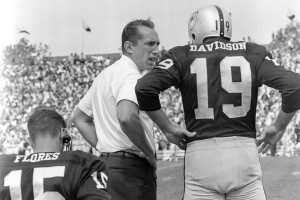
Lamar Hunt’s Dallas Texans, who would eventually become the Kansas City Chiefs, also turned to a guy who couldn’t cut it in the NFL, Cotton Davidson. He had a cup of coffee with the Baltimore Colts in the mid-1950s but had been out of football for 2 years when he joined the club. He only lasted 2 years in Dallas because the team’s coach, Hank Stram, decided to bring in a player he had a close relationship with while he was an assistant coach at Purdue, Len Dawson. Dawson and Stram went on to have great success. They won the AFL title in their first season together in 1962 and after moving to Kansas City upset the Minnesota Vikings in Super Bowl IV. Davidson didn’t fade away, however. He moved on to Oakland where he guided the Raiders through some tough early years into a successful transition to winning under Al Davis, from 1962 until 1968, sharing QB duties with a future Raider coach, Tom Flores.
 

Cotton_Davidson

Al Davis, Cotton Davidson talk strategy with Tom Flores nearby

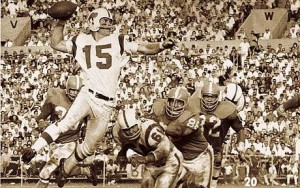
Sid Gillman, picked to coach the Los Angeles Chargers, came to the new league with the reputation of having built an offensive powerhouse with the Los Angeles Rams of the NFL in the ’50s. He did the same with the Chargers, at first using another recycled NFL signal caller in Jack Kemp. Kemp guided the team, in L.A. and in 1961 in San Diego, to title game appearances. The team went to rookie John Hadl in 1962 and faltered to a losing season. Early in ’62 they tried to sneak Kemp through waivers and the Buffalo Bills claimed him for the $100 waiver price. Another ex-NFLer, Tobin Rote, was brought in and he led the Chargers to a win in the title game in ’63. Rote and Hadl split the QB duties the next year but Hadl eventually won the job and developed into one of the AFL’s top stars. Meanwhile in Buffalo, Bills’ coach Lou Saban was thrilled to get the veteran Kemp to lead his team, and lead he did, combining a top offensive attack with the AFL’s best defense to win back-to-back championships in the mid-1960s. Buffalo had struggled to stabilize the QB position in their early years. Their first draft pick ever, college star Richie Lucas, was supposed to be the cornerstone of the new team but turned out to be a bust. The team cycled through no-names like Johnny Green, Tommy O’Connell, Warren Rabb, M.C. Reynolds and Al Dorow before Kemp came on board and steadied the ship.
jack_kemp

Jack Kemp fires a “jump pass” against the Oilers

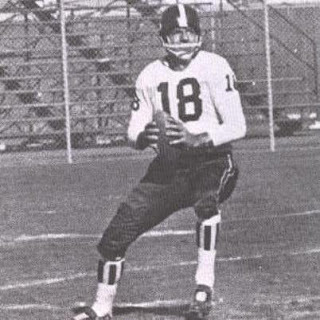
The New York Titans, like Buffalo, struggled to find a quarterback at first. Their initial starter was Dorow, but they swapped him out with the Bills for Johnny Green, and over time, tried the likes of Dick Jameison, Butch Songin, Lee Grosscup, Dick Wood, Galen Hall and Pete Liske before landing the guy who would save the franchise, and possibly the entire league, Joe Namath, in 1965. In Boston, the Patriots began their inaugural season with Songin under center. Seeing a pattern here? Yes, the early AFL teams pretty much played musical QBs with guys like Dorow, Green and Songin trying to find a combination that worked. The Pats found their man early in 1961 when Vito “Babe” Parilli took the reins of their offense. He led the team through most of the AFL’s existence and made them a solid Eastern Division contender almost every year. The final team of the 8 AFL original franchises for us to cover was the Denver Broncos. They were the losingest club of all among the AFL’s teams in the 10 year existence of the league and were so cheap they wore old high school uniforms with ugly vertical striped socks in their first year, but that didn’t mean they had no exciting quarterbacks. For a lousy team, they had some of the AFL’s most thrilling players, like Gene Mingo, Lionel Taylor and their QB, Frank Tripucka. Tripucka kept the faltering Denver team afloat in their first 4 seasons, guiding a wild and wooly offensive attack. A reject of both the NFL and the Canadian Football League, he played well enough in those early years that his jersey number 18 is retired by the franchise. When the Broncos signed Peyton Manning in 2012, Tripucka granted the Broncos permission to “unretire” the number so Manning could wear it. Tripucka eventually gave way to the likes of Mickey Slaughter, Jacky Lee and John McCormick as Bronco QBs, while the team compiled the worst record of all in the AFL’s existence. Almost all of these gladiator signal callers are mere footnotes in pro football’s 100 year history, but they all carved out their small slice of that history, collectively lifting up the sport until it grew into the television spectacle it is today.
franktripucka_broncos

Denver’s Frank Tripucka, sporting his vertical striped socks
 
Comments Off on NFL 100 – AFL Quarterbacks

Posted in Feature Stories, Football


Classic Team Logo of The Day

03 Oct

fortvalleystwildcats

Logo of a small college football team that plays in the Southern Intercollegiate Athletic Conference, the Fort Valley State University Wildcats. The school joined the conference in 1941, and Wildcat alumni who have gone on to play pro football include Greg Lloyd, Eddie Anderson, Rayfield Wright, Nick Harper and Tyrone Poole.

 
Comments Off on Classic Team Logo of The Day

Posted in Classic Team Logo of the Day


Classic Sports Card of The Day

03 Oct

66toppshadl

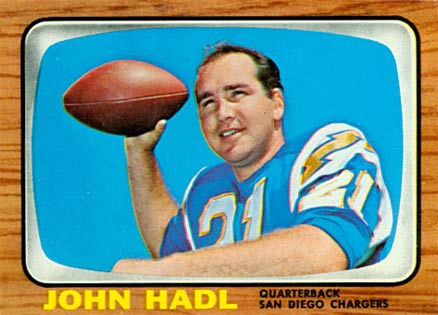
1966 Topps football card of former pro football quarterback John Hadl, who enjoyed a 16 year career in the AFL and NFL with 4 different teams, most notably the San Diego Chargers. He guided one of the AFL’s most prolific offenses with the Chargers, and was a 4 time AFL All Star. He led the league in passing yards and touchdowns in 1968. After retiring as a player he coached in various positions in both college and pro football, and is currently the associate athletic director at his alma mater, the University of Kansas.

 
Comments Off on Classic Sports Card of The Day

Posted in Classic Sports Card of the Day


NFL 100 – Chuck Noll

02 Oct

The subject of today’s NFL 100 feature is a man who almost singlehandedly turned around the fortunes of a struggling franchise, the Pittsburgh Steelers. That man was Chuck Noll, a no-nonsense, unassuming coach who disdained the spotlight. For that reason, he often gets overlooked in many discussions of greatest coaches of all time, but he certainly belongs there. Noll is considered a branch of the coaching “tree” of two of pro football’s most innovative minds – Paul Brown and Sid Gillman. He was an undersized offensive lineman while playing for Brown’s Cleveland Browns’ teams in the 1950s, and was used by Brown as a “messenger guard” to bring in plays from the coach to his quarterback, one of the legendary coach’s many innovations. Brown once said that Noll was a such a smart player that he could’ve just let him decide what play to send in rather than giving it to him. Brown’s “coaching tree” includes some all-time greats, namely Noll, Don Shula, Lou Saban, Weeb Ewbank and later in Cincinnati, Bill Walsh. Noll’s playing career lasted 7 years, all with the Browns, and included 2 championship seasons. He decided to retire at age 27 to hopefully begin a coaching career at his alma mater, the University of Dayton. To his surprise, Dayton didn’t offer him a job but the head coach of the Los Angeles Chargers of the new American Football League, Gillman, asked him to join his staff as an assistant. That staff included 3 future Pro Football Hall of Famers in Gillman, Noll and Al Davis.


Chargers60 (2)

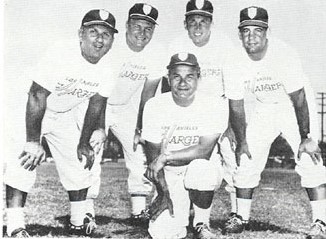
1960 Chargers’ coaching staff – Gillman kneeling, Joe Madro, Chuck Noll, Al Davis, Jack Faulkner

Noll worked on the Chargers’ staff for 6 seasons, a stint that included 5 championship game appearances, before moving on to Baltimore to become the Colts’ chief defensive coach (they didn’t designate them as “coordinators” back then), under Don Shula. His star began rising quickly at that point and within 3 years he got the head coaching job with the Steelers in 1969. The franchise was one of the worst in the NFL at the time, and would be moving over to the American Conference in 1970 when the merger of the two leagues became final. He didn’t find instant success there, either, as his first 3 seasons ended with losing records, including a one-win season in his first at the helm. The club showed gradual improvement and Noll and the front office used that time to load the team up with future stars. They added Joe Greene, Terry Bradshaw and Franco Harris and in the 1974 draft they plucked 4 future Hall of Famers in Lynn Swann, John Stallworth, Jack Lambert and Mike Webster. The franchise eventually turned the corner and became the dominant force of the league in the 1970s, winning an unprecedented 4 Super Bowls. Their “Steel Curtain” defense regularly shut down opponents and not only did they rule the decade, they never looked back to their losing ways in their early years. Noll coached from ’69 until he retired in 1991 but he set a standard for consistency and winning in the Steel City that still exists today. They’ve only had 2 more coaches since Noll – Bill Cowher and Mike Tomlin, each of whom has also won a Super Bowl. The shy, unassuming coach, who passed away in 2014, should be remembered as one of the greats of the game in its’ first 100 years.

chucknoll

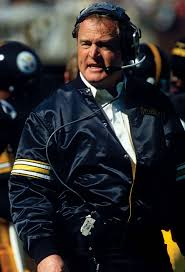
Steeler legend Chuck Noll

 
Comments Off on NFL 100 – Chuck Noll

Posted in Feature Stories, Football