RSS
 

Classic Sports Card of The Day

28 Jul


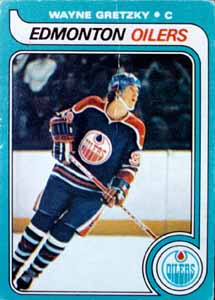
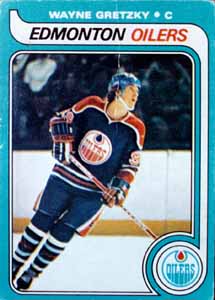
“The Great One”…Wayne Gretzky of the Edmonton Oilers, who is the greatest hockey player of all time, bar none. He shattered the NHL record book after joining the league along with the Oilers when the WHA folded. After helping the Oilers end the Islanders’ dynasty and winning multiple Stanley Cups, Gretzky was traded to the Los Angeles Kings in what is still considered the darkest moment in Canadian sports history. He helped the Kings to the Cup finals and finished his career with the New York Rangers, mostly as an attempt by the league to promote the game.


NFL – Best QBs Not In The Hall of Fame

27 Jul

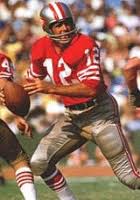
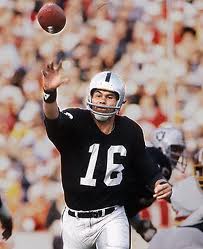
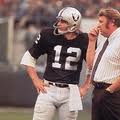
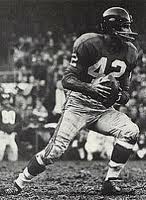
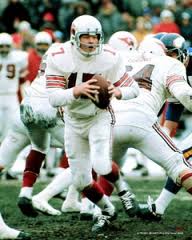
Above, from left: John Brodie, Jim Plunkett, Ken Stabler, Below: Charlie Conerly, Jim Hart.

The 2010 Pro Football Hall of Fame induction ceremony is coming up soon, with 2 slam dunk picks for the hall, Jerry Rice and Emmitt Smith, going in this season, among others. There is always a debate about players who belong in Canton who can’t seem to get in, and I’d like to highlight some of these players over the next few days, starting with quarterbacks today. The measuring stick for quarterbacks seems to be something that’s tough to get your arms around. Winning championships carries a lot of weight – that’s why Joe Montana, Otto Graham, Bob Griese and Terry Bradshaw are undisputed choices. Statistics count heavily also – Fran Tarkenton, Dan Marino, Sonny Jurgenson and Dan Fouts are examples of QBs getting in with big numbers but no titles. Using the “winning championships” argument, a case can be made for 2 former Oakland Raiders, Jim Plunkett and Ken Stabler. The Raiders being the bad boys of the NFL, and owner Al Davis constantly feuding with the league, seems to affect the Hall voting for one. Plunkett’s early-career perception of being a top draft choice bust while playing in New England works against him also, but he guided the Raiders to 2 Super Bowl titles and had a decent enough career after his Patriot debacle to warrant inclusion in the Hall. Stabler also had a reputation of being a rag-tag type of player in his time, but no one can dispute the winning he did while quarterbacking the Raiders. “The Snake” is a member of the NFL’s all-decade team for the 1970s, but isn’t good enough for the Hall? Two former New York Giants also fit this category. Charlie Conerly was a Giants’ mainstay in the late 1940s and 1950s, guiding the G-men to 3 NFL title games, beating the powerhouse Bears in 1956 to win it all. He was rookie of the year in 1948, league MVP in 1959 and a 2-time Pro Bowl selection, yet is not in Canton. Phil Simms was underappreciated his whole career, and this continues now as he has not gotten serious consideration by Hall voters either. Part of Simms’ problem is he was highly touted as a high draft choice and early in his career struggled to meet expectations. But once he figured it out, Simms was a key reason why New York won 2 Super Bowls (even though he was injured and didn’t play in one, he was instrumental in getting the team there). His career statistics are comparable to Griese’s, and he still holds the Super Bowl record for completion percentage. Frank Ryan, who quarterbacked the Browns in the 1960s, was a top signal-caller of that decade but lost a lot of playing time due to injuries. He led the Browns to the title game in 1964  and 1965, winning in ’64, but battled injury after that. He still compares statistically to Joe Namath, but lacks the flash and “legend” that Broadway Joe rode into Canton. Some forgotten players who had great careers but were stuck on losing teams include Ken Anderson, John Brodie, Jim Hart, John Hadl and Archie Manning. Anderson was the QB in Cincinnati when the Bengals offensive guru at the time, Bill Walsh, was tweaking Sid Gillman’s mad passing attack offense into what would become the “West Coast” offense, and rang up great numbers in that system. There is a groundswell of support for him and he may get in at some point. Brodie and Hart battled hard in the 1960s on mediocre teams in San Francisco and St. Louis respectively, and their lack of winning has worked against them. Hadl is an interesting case. Most of his work was done in anonimity in the American Football League, where he orchestrated Gillman’s wide open offense. Near the end of his career he had an MVP season with the L.A. Rams, leading them to a 12-2 season, and is a worthy HOF candidate, but it’s rare when players whose careers were mostly in the AFL get elected. Manning  had the bad luck of playing most of his career with an expansion team, the New Orleans Saints, and even though he is still appreciated and beloved in the Big Easy, he may only get to Canton to see his sons Peyton and Eli get inducted.


Classic Team Logo of The Day

27 Jul

This is the logo of the American Basketball Association’s Carolina Cougars, who played in the league from 1969 through 1974, after moving to Carolina from Houston. Judging from this logo, maybe the team name should have been the Carolina Pink Panthers, since there’s a striking resemblance. In its’ short existence the team had 2 of the ABA’s best known coaches, Larry Brown and Doug Moe, and at one time or another boasted the likes of Billy Cunningham, Mack Calvin, Bill Bunting, Joe Caldwell, Jim McDaniels and Steve “Snapper” Jones.


Classic Sports Card of The Day

27 Jul


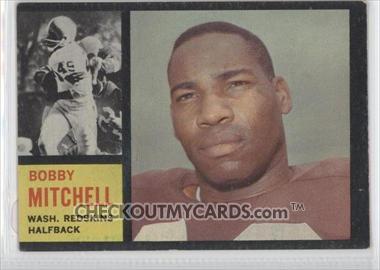
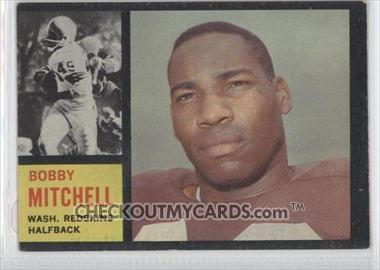
From www.CheckOutMyCards.com , a 1962 football card of Hall of Famer Bobby Mitchell. On this card Mitchell is listed as a Washington Redskin but is still wearing his Cleveland Browns uniform, having just been traded. He was a respected 1,000 rusher as a back with the Browns, but his being added to the Redskin roster was more than just your standard run-of-the-mill trade. He became the first African-American player on the last NFL team to integrate, and faced heavy prejudice when he arrived in Washington. The Redskins owner at the time, George Preston Marshall, was a staunch segregationist, and only added Mitchell to his roster after the government threatened to revoke his lease on the team’s stadium, which had been built with government money. Needless to say, Mitchell wasn’t welcomed with open arms. To his credit, he persevered as a Redskin player, and was one of many of that era to switch from the “halfback” to the “flankerback” position, essentially becoming a wide receiver rather than a runner.


NASCAR’s Roots

26 Jul

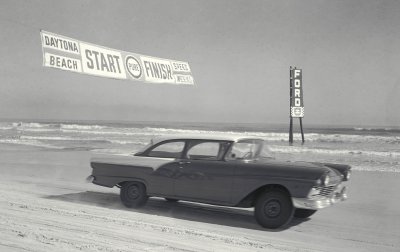
The recent opening of the new NASCAR Hall of Fame in North Carolina got me to thinking about the history of auto racing. NASCAR today is a mega-business, with the new Hall, sponsor-owned racing teams that are ultra-competitive and superstar drivers who are marketed like rock stars. Who hasn’t seen a commercial with Jeff Gordon, Dale Earnhardt, Jr., Tony Stewart or Jimmie Johnson in it? Even older NASCAR legends like Richard Petty and Mark Martin have cashed in on the sport’s popularity. I love exploring the historic past of sports, and the history of NASCAR racing is amazing. Pictured above is an old Ford racing in the Daytona 500, when the race still took place on the actual beach at Daytona. A legend of the sport from that early era is Junior Johnson, who, like many of the early drivers, learned their craft by running moonshine in Appalachia. Johnson’s NASCAR career began in 1953 and was briefly interrupted in 1956 when he was arrested while working on the family still and spent time in prison. The sport was, and in many ways still is, a Southern good ol’ boy sport. And of course, when you’re talking good ol’ boys, you know there’s going to be a “Junior” among the group. You have to love some of the other names and nicknames of the early drivers – Speedy Thompson, Fonty Flock and Fireball Roberts, who was tragically killed in an accident in 1964. I’ve never been to a NASCAR race but they say when you’re down near the track during the race that the cars produce a thunderous roar that is amazing. I’ve been to local tracks in Ransomville and Lancaster and been in the area down near the track, and I thought that was pretty great. I can’t imagine what it’s like at the NASCAR races. There’s no doubt the sport has become extremely popular today. I hope today’s drivers appreciate the pioneers who made it what it is, just like the early players in all sports. I’m not a big racing fan, but I still smile at seeing old grainy black and white films of the former moonshine runners racing on the beach at Daytona.


Classic Team Logo of The Day

26 Jul

Logo of another old World Hockey Association franchise, the Los Angeles Sharks. This team was originally named the L.A. Aces, but when the San Francisco Sharks moved to Quebec and dropped the name, the L.A. franchise grabbed it. The team played in the City of Angels from 1972 until 1974, then moved to Michigan. The franchise dissolved when the WHA disbanded, and is not related in any way to the current NHL San Jose Sharks.


Classic Sports Card of The Day

26 Jul

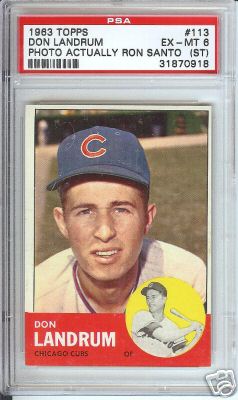
1963 Topps baseball card, supposedly of Chicago Cubs outfielder Don Landrum. Oops, another error! The picture on the card is of an all-time Cubbies’ favorite, third baseman Ron Santo. Santo was always one of the under-appreciated players of his time, usually playing second fiddle to Baltimore’s Brooks Robinson as far as third basemen of the 1960s. That continues even until today, as Santo has yet to be voted into the baseball hall of fame, an honor he clearly deserves. Landrum was a journeyman in his career, playing for 4 different MLB teams over a 10 year span.


Football Pep Talks

23 Jul

Famous football pep talks are a favorite subject of mine, and even though the famous Knute Rockne “Fight, fight, fight” speech is very inspiring, the ones I like best are the ones that are subtle. I guess if I were a player on a team, those are the kinds of speeches I would respond best to. Here are a few legendary but subtle football pep talks:

At halftime of a game in which his Notre Dame squad was playing poorly, Rockne never came into the locker room. His players sat there wondering what was going on, since the fabled coach was known for his halftime inspirational talks. Then, as the halftime was winding down, Rockne opened the locker room door, stuck his head in and said,  “OK. Half a minute left. Let’s go, girls!”

John Madden’s Oakland Raiders were about to take the field against their fierce division rivals, the Kansas City Chiefs. The Chiefs had a horse named Warpaint that would ride around the field when the Chiefs scored, ridden by a guy dressed in Indian garb, pretty much the Chiefs’ mascot. Madden, in his typical hyper style, red-faced and with arms flailing, yelled out “Hey! Hey! I don’t wanna see that damn horse on the field once today!!” Now I would run through walls for a guy like that.

Paul Brown’s Cleveland Browns had just been brought into the NFL after being a dominant team in the old All-America Football Conference, and for their first game in the NFL the Browns were scheduled to face the reigning league champion Philadelphia Eagles, led by their superstar back Steve Van Buren. The pundits of the day spent the week before the game writing how the Eagles would roll over the upstart kids from “that minor league” and how Van Buren would show the new kids from Cleveland how the game was played. The Browns players were a little worried that Brown, usually a master motivator, seemed to be mostly silent the whole week prior to the game as everyone in the press, and some in the Eagles organization, laughed at the prospect of the Browns competing against the NFL champs and having any chance of slowing down their backfield sensation, Van Buren. Then, as the team was getting ready to take the field, Brown turned to his players and uttered these words: “Just think, men, in a minute you’ll get to touch the great Steve Van Buren.” Final score: Browns 35, Eagles 10.

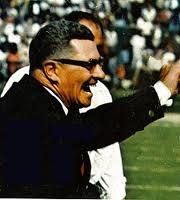
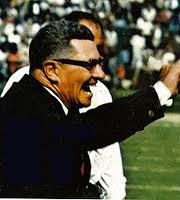
Vince Lombardi was known for his line “Winning isn’t everything, it’s the only thing.” He has actually been villified for that comment by some in society who feel that this philosophy goes too far, that it means to win at all costs and the hell with everything else. In today’s “everybody is special” society where people advocate not keeping score in sporting events and “every kid needs to receive a trophy”, Lombardi is considered somewhat of a villain. But those people don’t seem to understand that Lombardi was a great teacher of  not only the game but of life to his players. Many of his former players still say that decisions they made long after their playing careers were over were shaped by what Lombardi had taught them. Below is a short audio clip of a speech by Lombardi that is an example of his real philosophy, not just the one-line quote attributed to him. I think it’s pretty inspirational.
Unknown – Win Win Win


Classic Team Logo of The Day

23 Jul

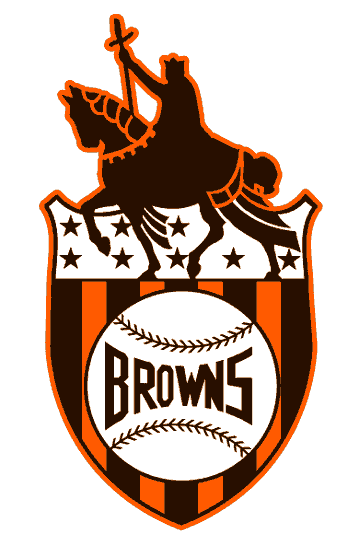
Here are a couple of extremely different logos from the same team, major league baseball’s old St. Louis Browns. On the left is the team logo used from 1936 until 1951, showing Saint Louis on horseback with sword in hand. Then in 1952, the logo was changed to the impish “brownie” shown on the right. The change coincided with Bill Veeck becoming owner of the franchise. Veeck is well known for his outlandish promotions, and as the Browns owner, he hired a midget, Eddie Gaedel, gave him uniform number 1/8, and sent him up to bat in a game. Gaedel, ordered not to swing, walked on 4 pitches, but his contract was voided the next day by the president of the American league. The team had little success in St. Louis, trying to compete for fans with the powerhouse  NL Cardinals, and eventually moved to Baltimore and became the Orioles.


Classic Sports Card of The Day

23 Jul

1972 Topps basketball card of NBA great Rick Barry. Barry was one of the league’s most prolific shooters in his career, and was the main cog in the Golden State Warriors’ unexpected title run in 1974. Barry was also one of the league’s greatest free throw shooters, using an unorthodox underhand style. Barry played a brief stint in the old ABA  (with 4 different teams) but his best known for his Bay Area years with the Warriors. He worked as an NBA television analyst after his playing career ended.