This is an “alternate” logo of the National Football League’s St. Louis Cardinals, incorporating the city’s Gateway Arch, used starting in 1966 when the Arch first opened. The Cardinals moved from Chicago to St.Louis after the 1960 season, and played there until 1987 when owner Bill Bidwell moved them to Arizona. They had exciting teams during their stay in St. Louis but never won any championships. Coach Don Coryell, known for his “Air Coryell” offense in later years in San Diego, coached the Cardinals in St. Louis. Some notable players from the St. Louis years are Jim Hart, Dan Dierdorf, Sonny Randle, Bobby Joe Conrad, Jackie Smith, Larry Wilson, Roger Wehrli, Ernie MacMillan, John David Crow, Roy Green, Terry Metcalf and Conrad Dobler.
Classic Sports Card of The Day
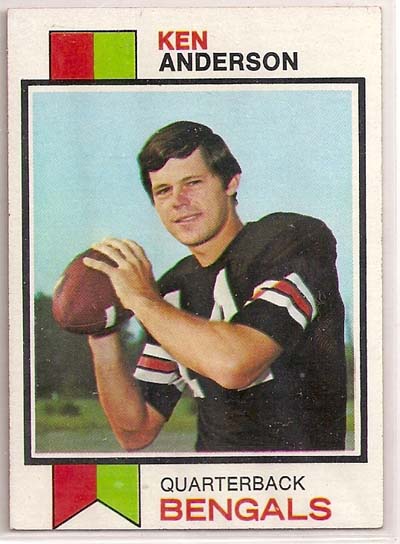
1973 Topps football card of former Cincinnati Bengals quarterback Ken Anderson. Drafted by the Bengals in 1971, Anderson earned the starting job by 1972 and led the team for 16 years. His position coach when he started out in Cinci was Bill Walsh, and Anderson was the first QB to direct Walsh’s “West Coast” offense. He guided the Bengals to the Super Bowl in 1981, losing to Joe Montana’s 49ers, and ranks second behind Montana in postseason quarterback rating at 93.5. Anderson was a 4-time Pro Bowler in his career and has come close to election to football’s Hall of Fame but so far hasn’t made it in. Anderson has also dabbled in coaching since retiring, serving as an assistant for the Bengals, Jacksonville and Pittsburgh.
Classic Team Logo of The Day
Logo of the National Basketball Association’s Phoenix Suns, used from the team’s first season in 1968 until 1992. The Suns have been a pretty successful franchise, owning the fourth best winning percentage of all time, but in their four decades of existence have never won an NBA title. When the Suns entered the league in ’68 along with Milwaukee as an expansion team, then NBA commissioner Walter Kennedy was against the move, calling Phoenix “too hot, too small and too far away” to be a successful market. Some of the Suns’ star players from their early years include the Van Arsdale brothers, Tom and Dick, Alvan Adams, Ricky Sobers, Paul Westphal and Garfield Heard.
Classic Sports Card of The Day
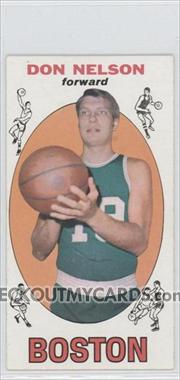
1969 Topps basketball card of former Boston Celtic Don Nelson. Nelson started his National Basketball Association career with the Chicago Zephyrs in 1962, played 2 years with the Los Angeles Lakers, then signed on with the Celtics, where he played the last 12 years of the 15 he totaled. Nelson was one in a long line of Celtic “sixth men”, an important part of the team’s winning formula as the first man off the bench to spell the starters. He played on 5 Boston championship teams. Nelson entered the NBA coaching ranks after he retired, and became the winningest coach in league history, guiding the Milwaukee Bucks, New York Knicks, Dallas Mavericks and Golden State Warriors. As a coach, he was an innovator, and invented the “point forward” position that a lot of teams use today. His unique system became known as “Nellyball”.
NFL – Bills’ Game Review
Sunday’s Buffalo Bills’ game was similar in a lot of ways to last week’s game in Cincinnati. In the first half the Bills were totally dominated by the Steelers, who methodically marched up and down the field and controlled the clock. The Bills offense was shut out but really had little opportunity to get anything done since they rarely had the ball. The defense wasn’t terrible but couldn’t stop anything on third down. To their credit, despite being dominated the defense only surrendered one touchdown, minimizing the damage to a 13-0 halftime deficit. The Bills missed a chance to get back in the game when they took the second half kickoff and drove down the field, only to turn the ball over in the red zone on a fumble by Lee Evans. The play of the defense, just like in last week’s game, improved immensely in the second half. They managed to get pressure on Ben Roethlisberger, taking advanatage of Pittsburgh’s patchwork offensive line to record 5 sacks and draw numerous holding penalties. Jairus Byrd came up with a turnover, and Kyle Williams continued his push toward a Pro Bowl bid with a monster game, totaling 10 tackles and 2 sacks. Ryan Fitzpatrick did another admirable job directing the offense, spreading the ball around to all his receivers. Fred Jackson started the Bills on the road to another comeback by taking a screen pass 65 yards for a touchdown. It looked as though the Bills were left for dead when Troy Polamalu made a spectacular diving interception at his own 1 yard line to kill a Bills’ drive toward at least tying the game, but coach Chan Gailey used his timeouts well, and the defense held to give Fitzpatrick one more chance to deliver. Fitzpatrick, who continues to lock up the team’s starting QB job, did just that, driving the team to give Rian Lindell a chance to kick a game-tying field goal with 2 seconds left and force overtime.
There is no denying that the play of the game was the dropped pass by the Bills’ Steve Johnson in the overtime that would have given his team the upset win. It was another example of what the Bills have been doing all season – finding new and creative ways to lose. It’s really a shame that Johnson wound up being the goat, since he has been a huge bright spot in a losing season this year for the Bills. It was encouraging to see Johnson man up and face the media after the game, and to take individual responsibilty for the loss, calling the drop inexcusable. It’s important to point out, however, that Lee Evans fumbled away a scoring opportunity early in the game, and also dropped a pass in the OT. Jackson and Leodis McKelvin both fumbled but were bailed out by teammates who recovered them (Evans redeemed himself somewhat by recovering Jackson’s fumble). Paul Posluszny and Chris Kelsay missed opportunities for sacks with poor tackling, and Arthur Moats tripped up McKelvin on the overtime kickoff when it appeared he had a chance to go the distance. Games are never really won or lost on one play, and Buffalo certainly blew a lot of other chances to make plays at various times that could have made the difference. Unfortunately, Johnson’s drop was the most glaring, and he’ll surely be crucified for it all week in the media.
Classic Team Logo of The Day
Here is another logo of Triple A minor league baseball team, the Portland Beavers. the Beavers were a charter member of the Pacific Coast League in 1903. The Beavers’ franchise has faded from existence and been brought back to life several times over the years, most recently in 2000 when this logo was put into use. The Albuquerque Dukes were sold and moved to Portland that year and renamed the Beavers, and were affiliated with the San Diego Padres. The Beavers were the minor league affiliate of the Cleveland Indians for most of the 1960s, and some of their alumni from that era are Luis Tiant, “Sudden Sam” McDowell and Lou Piniella.
Classic Sports Card of The Day
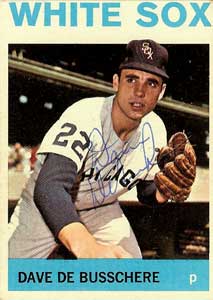
1964 autographed Topps baseball card of a basketball player, Dave DeBusschere. DeBusschere pitched 2 seasons for the Chicago White Sox, 1962 and ’63, while also playing pro basketball for the Detroit Pistons. After the ’63 season he turned to pro basketball full time, and in 1964 even served as the Pistons’ player/coach for a short time, becoming the youngest coach in NBA history. His career blossomed when he was traded to the New York Knicks in 1968, as he became a key member of the Knicks’ championship teams of 1970 and 1973. DeBusschere was an eight time NBA All Star, voted to the league’s 50th Anniversary All Time team, and was inducted into the basketball Hall of Fame in 1983. DeBusschere died of a heart attack at age 62 in 2003.
Classic Team Logo of The Day
Logo of the Niagara Falls Flyers, a “Tier 1” junior “A” Ontario Hockey League team that played from 1976 until 1982. The club was moved to Niagara Falls from St. Catharines, Ontario in ’76, and it was the second incarnation of the team, under the same owner as its’ predecessor, which played from 1960 until 1972. Two future Hall of Famers played in the Falls, Bernie Parent with the initial Flyer team, from 1963 to 1965, and Mike Gartner from 1976 until 1979. The Flyers were sold and moved to North Bay, Ontario after the ’82 season.